Design Thinking and Marketing: How Empathy Builds Better Content, Better Strategy, and Better Results
- SHARE ON:



A practical guide from the Click2View team
Design thinking isn’t a buzzword anymore; it’s become the quiet superpower behind the world’s most effective marketing teams.
Not because someone stuck Post-its on a wall, but because brands that start with empathy make better decisions.
They create content people actually want, avoid waste, and innovate without gambling the entire budget on guesswork.
Instead of asking “What should we make?”, design thinking forces a much better question:
“Who are we making this for, and what do they actually need?”
Apply that mindset to marketing and suddenly everything becomes clearer: your content strategy, your audience insights, and even how you prioritise ideas.
It’s practical, human, iterative, and refreshingly grounded.
What Design Thinking Really Is (And Why Marketers Should Care)
Design thinking is a structured and human-centred way of solving problems.
It starts with empathy: through understanding what people really need, and defining their pain points.
These insights get translated into generating ideas, prototyping them quickly, and testing them with real users.
It’s not about visuals or VFX; it’s a decision-making framework that helps marketers reduce waste, increase relevance, and build solutions that genuinely work for their audience.
Design Thinking vs Traditional Marketing Planning
Traditional marketing planning often starts with internal constraints:
- Budget
- Timelines
- Channels
- Past performance
Design thinking flips that sequence.
Instead of asking “What can we execute this quarter?”, it asks:
“What problem is our audience trying to solve right now?”
This distinction matters because traditional planning tends to optimise execution efficiency, while design thinking optimises outcome relevance.
In practice:
- Traditional marketing often produces more output
- Design thinking produces more impact
When teams start with empathy, they’re less likely to ship content that looks polished but lands flat.
They prioritise usefulness over volume and clarity over cleverness.
This doesn’t slow marketing down.
It prevents teams from moving fast in the wrong direction.
A famous example – Airbnb: Empathy that transformed a struggling startup
Airbnb’s early growth was flat, and no amount of spreadsheet analysis explained why.
So the founders applied a design-thinking approach: they stayed in hosts’ homes, talked to guests, and experienced the product exactly as users did.
They uncovered simple human problems like bad photos, unclear listings, trust issues that no data dashboard was surfacing.
They prototyped fixes fast, tested them with real users, and saw immediate improvement.
Lesson: when you start with real human insight, you solve the problems that actually matter.
Another famous example – Google’s design sprint: Making design thinking fast and practical
Google Ventures created the Design Sprint, a five-day process that compresses the entire design-thinking cycle: empathy, mapping, ideation, prototyping, and testing, into one focused week.
Teams prototype a solution on Day 4 and test it with real users on Day 5. This approach has shaped countless apps, onboarding flows, and product decisions across the tech world.
Lesson: you don’t need months to learn what works. With structured design thinking, you can find clarity in days.
Design thinking isn’t about fonts, colours, or creative flair. It’s a structured way of understanding people so you can design better solutions.
In this case, better marketing.
The classic cycle is:
- Empathise
- Define
- Ideate
- Prototype
- Test
It’s human-centred and iterative, which makes it ideal for navigating today’s messy, non-linear customer journeys.
Marketing built on design thinking becomes smarter, clearer, and much more effective, because it’s anchored in what people actually need.
Empathy: The Starting Point of Every Design Thinking and Marketing Strategy
Everything begins with empathy.
Not the fluffy kind, the practical kind.
It means understanding:
- What your audience is trying to achieve
- Where they struggle
- How they behave
- What motivates them
- What frustrates them
- What they value
Many businesses think they’re being customer-centric while actually viewing everything through a product lens.
But design thinking forces a shift to the customer’s world, where the real insights live.
Because real empathy comes from observation, and not guesswork.
You need to watch how people behave, and not what they claim to want.
Marketing that lacks empathy becomes noise.
But marketing built on empathy becomes useful.
That’s where innovation actually begins.
How Design Thinking Improves Cross-Functional Marketing Teams
Design thinking isn’t just a creative tool; it’s an alignment tool.
Modern marketing teams rarely work in isolation. They collaborate with:
- Sales
- Product
- Customer success
- Leadership
- External agencies
Without a shared framework, teams often argue opinions instead of solving problems.
Design thinking provides common ground:
- Empathy research aligns everyone around the same customer reality
- Clearly defined problems reduce subjective debates
- Prototypes make abstract ideas tangible
- Testing replaces internal politics with evidence
When everyone agrees on who the work is for and what problem it solves, execution becomes faster, and friction drops dramatically.
This is especially valuable in B2B environments, where multiple stakeholders influence messaging and priorities.
Turning Customer Insight Into Action
Once you’ve understood your audience, the next step is to articulate the real problem.
Examples:
- “Our audience is overwhelmed, not uninformed.”
- “Decision-makers need clarity, not more content.”
- “Users know the ‘what’ but not the ‘how’.”
- “Our messaging doesn’t match their actual workflow.”
When you define the problem clearly, everything downstream, like content, messaging, creative direction, naturally becomes sharper.
Instead of trying to say everything, you focus on saying the right thing.

How to Generate Better Marketing Ideas with the Design Thinking Process
Ideation is where you generate possibilities, not polished campaigns.
This step is powerful in marketing, because it encourages:
- Multiple content formats
- Different storytelling angles
- Alternative customer journeys
- Diverse creative approaches
- “What if?” experiments
The goal isn’t perfection. It’s exploration.
Quantity leads to quality.
Prototype Your Marketing Before You Commit Budget
In product design, teams build rough prototypes.
But in marketing, prototypes look a little different, even though they serve the same purpose.
Modern examples of marketing prototypes:
- Draft landing pages
- Headline variations
- 15-second teaser videos
- Thumbnail concepts
- Storyboard outline
- Sample social posts
- Content skeletons
- Mock email flows
It’s important to build a habit of “externalising” ideas, so people can react to them.
Prototypes shouldn’t be precious: they should be fast, imperfect, and cheap.
So prototype early, don’t worry about it being ugly, and make sure you do it often.
Test, Learn, Iterate: The Modern Marketing Loop
Testing is the heartbeat of design thinking.
It’s not about seeking validation; it’s about seeking truth.
Modern marketing tests can include:
- A/B copy tests
- Messaging angle tests
- Short-form video tests
- Heatmap analysis
- Qualitative interviews
- Behavioural analytics
- Community feedback
- Split-test creative variations
Your goal isn’t to “get it right.” Your goal is to learn fast, then improve.
Iteration is not rework. It is the strategy.
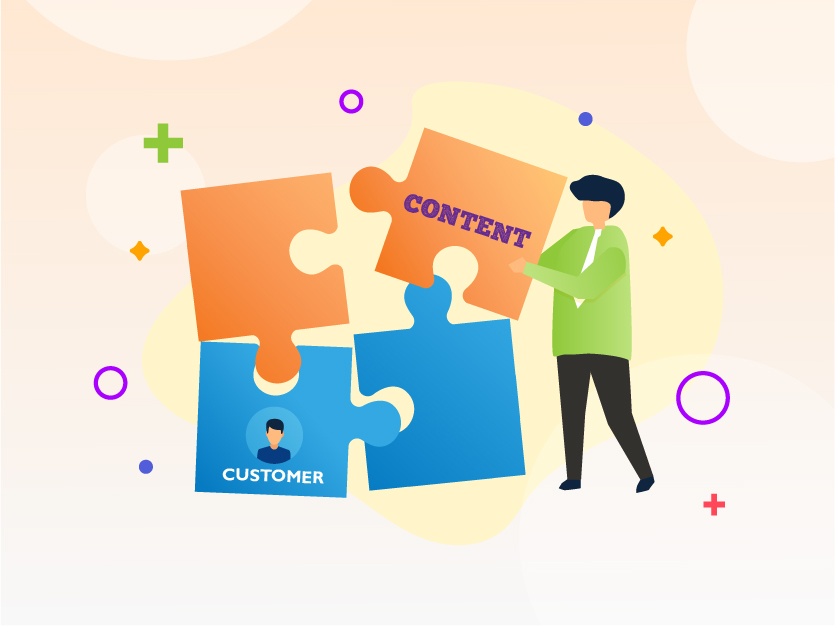
Treat Content Like a Product (and Not a One-off Asset)
One of the strongest shared messages from both original articles: nothing is ever “done”.
Content behaves like a product: it needs updates, pruning, refinement, and evolution.
In practice, this means:
- Revisiting high-performing content
- Updating outdated articles
- Removing pieces that no longer serve
- Repurposing strong ideas into new formats
- Applying new insights to existing assets
- Refining CTAs, tone, and structure
Content that evolves stays relevant, and content that stays static decays.
Design Thinking in Long-Term Brand Building
Design thinking isn’t just useful for campaigns or content experiments. It plays a critical role in long-term brand building.
Brands that apply design thinking consistently:
- Develop clearer positioning
- Maintain a more coherent voice
- Avoid reactive trend-chasing
- Build trust through relevance, not repetition
Instead of constantly reinventing themselves, these brands evolve deliberately.
Empathy keeps the brand grounded in real audience needs.
Iteration keeps it current without losing identity.
Over time, audiences don’t just recognise the brand; they understand it.
How Design Thinking Reduces Marketing Waste and Risk
Businesses often produce content or campaigns, simply because they think they “should.”
This is called content for content’s sake: expensive, unfocused, and out of touch.
Design thinking prevents this because it:
- Aligns creative output to real needs
- Tests ideas before heavy investment
- Identifies dead ends early
- Keeps teams close to the audience
- Replaces assumptions with insight
The result?
Fewer wasted hours, fewer misaligned campaigns, and more meaningful marketing.
Measuring the Impact of Design Thinking in Marketing
Design thinking doesn’t replace metrics, it improves them.
You can see its impact through:
- Higher engagement quality (time on page, scroll depth, saves)
- Better content longevity and reuse
- Faster learning cycles
- Fewer failed launches
- Stronger alignment between content and conversions
Qualitative signals matter too:
- Sales teams referencing content more often
- Prospects mentioning specific stories
- Customers feeling “understood” by messaging
When marketing solves real problems, then performance tends to follow.
Where AI fits into the Design Thinking Approach
AI isn’t replacing design thinking; it’s accelerating it.
AI helps speed up:
- Audience research synthesis
- Clustering feedback
- Generating content variations
- Prototyping copy and visuals
- Sentiment analysis
- Journey mapping
- Micro-tests and rapid validation
But they fundamentally have different functions.
AI multiplies efficiency, while design thinking ensures direction.
Together, they make marketing both faster and smarter.
Co-creation and customer feedback loops in marketing

Marketing no longer happens in isolation, and your audience is part of the process.
Modern co-creation includes:
- UGC contributions
- Community discussions
- Interactive polls
- Beta groups
- Customer advisory panels
- Comment-led iteration
- Social listening for ideation
This is design thinking in action: not asking the audience what they want, but learning from how they behave.
Applying Design Thinking to Your Content Strategy (A Step-by-step Guide)
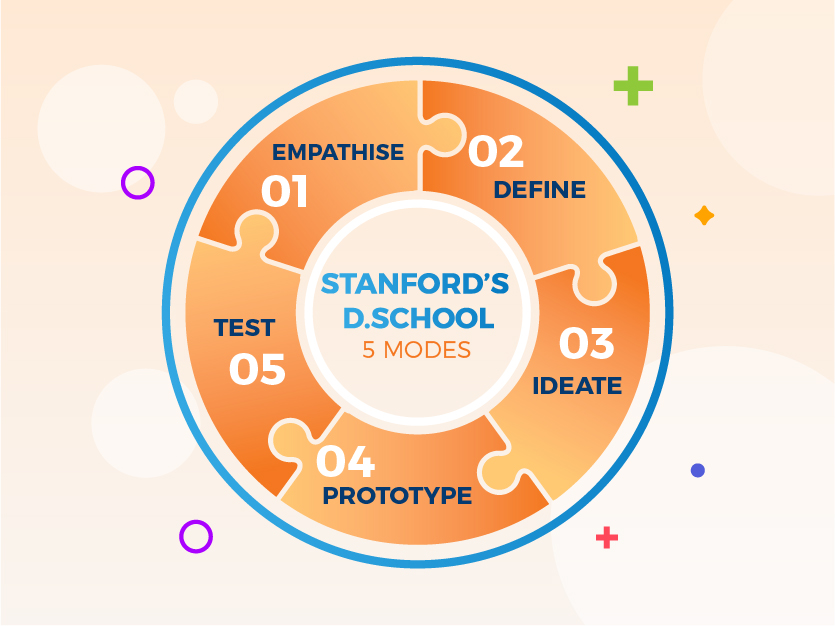
Here’s how the full cycle translates directly into content strategy:
1. Empathise
Understand what your audience is trying to achieve, where they’re stuck, and what information actually helps.
2. Define
Turn those insights into a clear content problem: “What is the audience trying to do that our content can support?”
3. Ideate
Brainstorm topics, formats, hooks, angles, and storytelling approaches.
4. Prototype
Create rough drafts, sample posts, thumbnails, titles, or snippets.
5. Test
Publish small-scale versions, run polls, gather data, and measure response.
6. Refine
Optimise based on what you learn: tone, structure, CTA, and format.
7. Scale
Turn the winning version into a full campaign or content series.
This process ensures your content is relevant, helpful, and grounded in reality.
A Simple Workflow for Marketing Teams
- Empathise → Observe real behaviour
- Define → Articulate the real problem
- Ideate → Generate multiple routes
- Prototype → Build quick versions
- Test → Learn from real users
- Refine → Improve the idea
- Scale → Invest in what works
This loop builds clarity, reduces risk, and keeps your content connected to your audience.
Pro Tips for Marketers Using Design Thinking
- Prototype early, and prototype cheap.
- You learn more from five real users than fifty opinions.
- Data tells you what; empathy tells you why.
- Iteration isn’t rework; it’s strategy.
- Good marketing solves problems, not guesses at them.
- Content is a product. Treat it like one.
Conclusion
Marketing that begins with people always outperforms marketing that begins with assumptions.
Design thinking reconnects teams to their audience, clarifies priorities, and creates a culture of purposeful experimentation.
Empathy sharpens insight.
Iteration sharpens ideas.
Testing sharpens results.
When you combine them, you get marketing that works: not because it’s trendy, but because it’s true to what customers actually need.
Design thinking doesn’t just make content better.
It makes marketing better.
FAQs
- How is design thinking useful for marketers?
It helps teams understand customers, test ideas early, and build content that solves real problems.
- Does design thinking work for B2B?
Yes, B2B audiences have specific needs that benefit from empathy and iterative testing.
- What’s the biggest benefit of design thinking?
Reduced waste and clearer strategic direction.
- How does AI support design thinking?
AI speeds up research, prototyping, and testing.
- Is design thinking only for big brands?
No; in fact, small teams benefit even more because it avoids costly missteps.
- How do I start applying design thinking?
Begin with observing your audience and defining a real problem worth solving.